
2024-03-05: Super Tuesday
The future is what we make of it

The Hill We Climb
If you’re in a Super Tuesday state, I do hope you will take (or have taken) the chance to vote. Living in a purple place (the California 45th is D+2, but currently represented by a Republican) does focus the mind a little. I’m a vote-by-mail kind of guy, but I also have a quirk about not wanting to drop my ballot in the mail on the day of, so I went down to the library to piggyback dropping off my ballot and getting a couple books—presumably I will finally read Count Zero. As someone whose professional life includes a lot of data, sometimes polling data, I found this Kevin Collins Bluesky post amusing:

(Editor’s note: it occurs to me that when this finally gets posted, polls will probably be closed in most of the relevant places. If you’re in these parts, you know what I mean. If you’re not: go vote when the time comes.)
I’m going to fail again at not focusing on being political again for a little bit. I know many people are despondent about the Supreme Court decision forcing Trump onto the ballot in all the states. Mark Joseph Stern has my opinion on the matter covered in his Slate piece. There is a thing going on that I think is happening in pieces of the 55-60% of the American farthest to the political left that I tried to take up last month. We are, right now, in a constitutional crisis. That’s been true since January 6th, and was at least arguably the case earlier. This is part of what I meant when I implored everyone to stop looking for the bottom with Trump. There isn’t one. There are people who are attached to American conservatism who do have one, but they are in the midst of figuring out a situation that is complicated for them (but shouldn’t be—come join us!) and I wouldn’t be relying on them to solve the problem now.
It’s easy, as Rex Smith notes, to simply feel despondent and disengage when the moment does not seem to be with you. But I agree with Michael Podhorzer that democracy is not a spectator sport. Sometimes, for some people, it can be, if we are being honest. For much of my life, it’s been possible to be more analytic then engaged about politics, which reflects both the political world and my own status as someone playing life on the lowest difficulty setting (John Scalzi is great). We aren’t there now. The analogy I like to draw is that we are living through something approximating Bleeding Kansas, with a certain amount of political violence and a lot of machinations around the vote. It did not end well. The distinction now is that as much as the current electoral map will remind you of the Election of 1860:
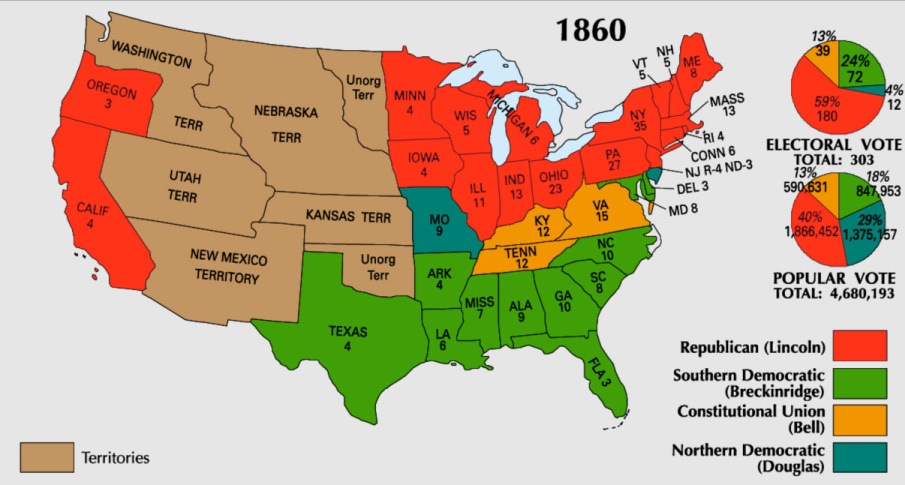
The limit of the Bleeding Kansas analogy is that I don’t think we have a Civil War coming. Here’s the map from the 2020 presidential election:
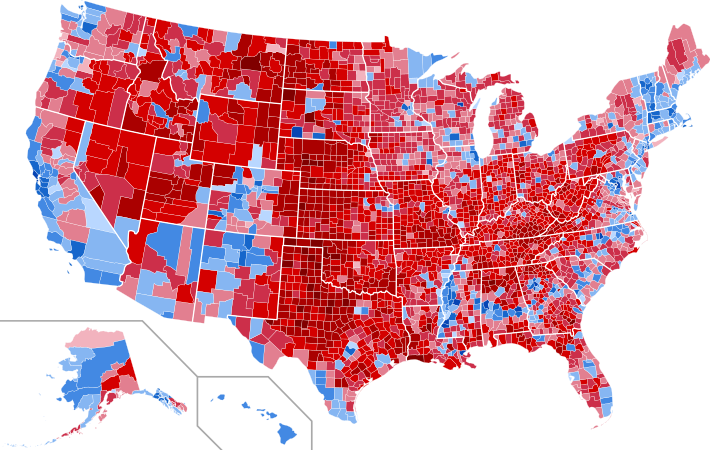
There is a state overlay to this, but the current dynamic is that voting for Democrats comes largely in urban area or areas that are very nonwhite. Republicans largely control the vote in exurban America. Yes, in the aggregate, it does mean that California and New York favor Democrats much more than Mississippi and Texas, but the Black Belt, Dallas, and Houston, are much more inclined to vote for Democrats than Siskiyou or Hamilton Counties. While it’s not impossible, our current political conflict turning into something closer to an actual war seems unlikely to me. An American version of the Troubles, though, is very much in play.
My argument for the moment is Podhorzer’s: be involved. Our lives and pathways to action are very different these days; it’s not always clear what we should do. But every meaningful bit of progress we’ve had in this country—the Civil Rights Movement, women’s suffrage, the fight against dangerous workplaces and child labor, etc.—are all fights that were taken up by large coalitions of the American people. Those coalitions were not perfectly unified and they did not exert the same kinds of force, nor use the same tactics, but the variety of constituencies and approaches is a feature, not a bug. If you don’t agree with my normie Californian politics and want something farther away from where the republic is at the moment, have at it. Agitate for your position! That’s how this is supposed to work. It’s not a thing that’s supposed to be easy; the Poles who finally ousted the Law and Justice Party defeated a system rigged against them (and are still struggling mightily against it). In Russia, Alexei Navalny paid the ultimate price for the fight, but Russians who simply honored Navalny were themselves risking their freedom.
But good things are possible. The examples I used earlier—people fighting for civil rights, women’s suffrage, and greater labor freedoms—won important, if incomplete successes. It was not a straight line for the Scandinavian countries to enjoy a shared prosperity, high levels of social cohesion, and the highest levels of reported happiness in the world. Rwanda built the best version of the nation that’s ever existed in the wake of a genocide. Most of us have the habit of not being involved, but a better world is worth making.
In Brief
Via the University of Cambridge: Pythagoras was wrong: there are no universal musical harmonies, study finds. This is interesting, perhaps not surprising if you think about it. Even as someone who is probably in the 99th percentile in terms of the amount of microtonal/xenharmonic music I’ve listened to, it seems to me that the decisions about tonality we made hundreds of years ago are still going to shape the way we hear music for the foreseeable future. That said, listening to perfectly quantized music also sounds weird to me. I guess that’s a cousin to the question of whether traditional African music styles can be transcribed.
Eleanor Janega: On women’s anatomy and the power of paying attention. Not to put too fine a point on something we usually discuss in an NSFW context, but we really are just talking about paying the most minimal level of attention here.
Gabriel Mays: How I’m (re)learning math as an adult. It’s basically an ad for Math Academy, but it’s funny for me in that I have been doing DIY math for so many years. I have the sort of mathematical background you’d expect if you studied stats in a Sociology major, read a bunch of Bill James and Baseball Prospectus, and had an advisor as a History grad student who also periodically taught stats. Every time I talk with a real Data Scientist, I feel a little bad as a guy who tinkers in Data Ops who’s reasonably clever, but not anything approximating a full-blown statistician. I feel a little like my grandfather, who took a job as an aerospace engineer without a high school diploma and discovered one day that he basically needed to learn Trigonometry overnight (yes, I took Trig in high school…I’m just sayin’…).
Revamping production tactics to control blueberry nursery diseases. As a blueberry fan, I wish them luck.
Gustavo Arellano joined the exodus to Beehiiv. But, in his case, from MailChimp.
Bluesky has launched RSS feeds. It’s also now open to everyone, so if you have new microblogging needs, feel free to hit me up.
I discovered today that PopCon is in Los Angeles this year. I don’t have enough time left to get off from work to go, but I definitely wish I did. Even setting aside George Clinton and Wendy and Lisa, there are a whole bunch of people I like there: Glenn McDonald, Natalie Weiner, Justin Hiltner, Charles Hughes, Karla Schickele, and so on. If you’re going, let me know how it was!
The Sports Section
Dartmouth’s Men’s Basketball Team voted to unionize 13-2. Chase Griffen has a really good quote in the Guardian piece.
Christian Meier, now an ultra-marathoner.
Alex Caple/Anfield Watch: Jurgen Klopp makes his biggest ask of Joe Gomez yet; he's become invaluable. Watching Gomez go from being a CB that will play on the right every now and then to being the LB/CB/RB who now plays the 6 for a team succeeding against all odds is kind of amazing.
Javier Mascherano wants Lionel Messi to play in the Argentine Olympic team.
So long (for now) and thanks for all the fish!